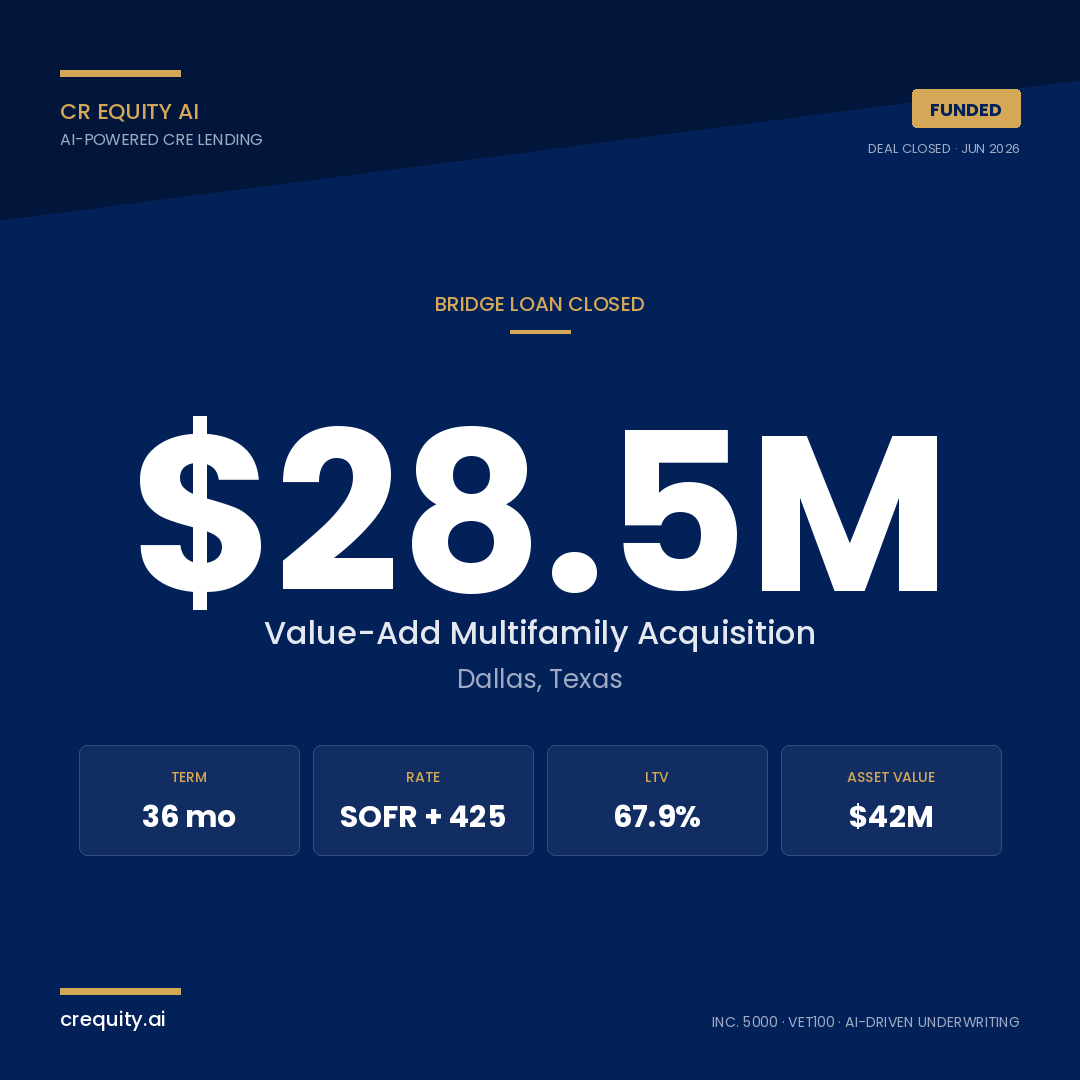
17 Days From Term Sheet to Wire: CR Equity AI Funds $28.5M Dallas Multifamily Bridge Loan
In a market where transitional capital often takes 45 to 90 days to close, CR Equity AI just funded a $28.5 million floating-rate bridge loan in 17 days — measured from the initial execution of terms to the borrower’s wire. The transaction financed the acquisition and value-add repositioning of a Class B multifamily asset in Dallas, Texas.
The close is a clear demonstration of what CR Equity AI was built to deliver: speed, agility, and capital placement working as a single system. Credit goes to our private equity capital partner, whose conviction on the deal and capacity to deploy capital on a compressed timeline made the 17-day execution possible.
Deal at a Glance
Metric Detail Loan Amount $28,500,000 Loan Type Floating-Rate Bridge Loan Program Value-Add Multifamily Term 36 months + extension options Interest Rate SOFR + 425 bps Asset Class Multifamily (Class B) As-Is Asset Value $42,000,000 Loan-to-Value 67.9% Time to Close 17 days (term sheet → wire) Market Dallas–Fort Worth MSA
Why a 17-Day Close Matters in Today’s Bridge Market
This asset was in Foreclosure! Meaning held in Trust.
For sponsors competing on value-add multifamily acquisitions, certainty of close at speed is the difference between winning a deal and watching it trade to someone else. Sellers in 2026 are increasingly favoring buyers whose lenders can demonstrate execution velocity, particularly as bank lenders have continued to pull back from transitional CRE.
A 17-day close compresses the typical bridge loan timeline by roughly 60–70%. That compression comes from three operational levers, each of which CR Equity AI’s platform is engineered around:
-
AI-accelerated underwriting. Our proprietary AIVAA platform produces a data-driven AVM valuation, sponsor evaluation, and credit memo in hours rather than days. This collapses the front end of the deal cycle, where most bridge transactions lose time.
-
Pre-positioned capital partners. Rather than syndicating each deal individually, CR Equity AI works with committed capital partners — including private equity, family office, and institutional debt funds — that have pre-aligned credit parameters. When a deal fits the box, capital is ready.
-
Parallel-track diligence. Title, third-party reports, and legal documentation run concurrently with underwriting, not sequentially. The deal team treats every workstream as critical-path until the last one closes.
Market Context: Dallas–Fort Worth Multifamily in 2026
The Dallas–Fort Worth metro remains one of the most actively traded multifamily markets in the United States, but the investment thesis has shifted. The cyclical peak of Class A rent growth has moderated as a historic delivery pipeline of new product works through lease-up, with concessions becoming more common in the top-tier segment.
That supply-side pressure has created a structural opportunity for value-add strategies in well-located Class B and Class C properties. These assets sit at a meaningful discount to replacement cost, draw a renter base increasingly priced out of new construction, and are insulated from the direct rent competition pressuring Class A operators. Capable sponsors who can acquire below replacement cost, execute targeted capital improvements, and re-tenant at modestly upgraded rents are still finding compelling risk-adjusted returns in this environment.
From a capital markets perspective, the environment continues to favor disciplined, well-structured bridge debt. Bank lenders have tightened underwriting standards on transitional assets and reduced leverage on loans involving future funding for capex and lease-up risk. This has expanded the addressable market for private credit lenders like CR Equity AI, which are structured to underwrite asset-level business plans and provide flexible, short-term capital for repositioning projects.
The Capital Stack: Private Credit + Private Equity Partnership
This transaction was funded through CR Equity AI’s private credit channel in partnership with a private equity capital provider whose mandate aligns with bridge-stage, value-add multifamily opportunities in growth metros. The structure delivered the sponsor:
-
A 67.9% LTV bridge facility with an embedded equity cushion that protects the lender position
-
Future funding provisions tied to specific construction and leasing milestones, ensuring capital is deployed as the business plan progresses
-
A 36-month term with extension options, providing sufficient runway to complete renovations, stabilize the asset, and refinance into permanent agency debt from Fannie Mae or Freddie Mac
The likely takeout is a stabilized agency execution once net operating income reaches pro-forma. The bridge term and structure were sized specifically to support that exit.
Speed, Agility, Capital Placement — Operationalized
CR Equity AI’s value proposition is not a tagline. It is a stack:
-
Speed is AIVAA producing institutional-grade AVM valuations and credit analysis in under two hours, plus parallel-track diligence that compresses the back end of the deal cycle.
-
Agility is a program suite that spans bridge (Flex 50™, BTFU™), Non-QM investor loans, in-ground asset finance, crypto-backed liquidity, and business capital — meaning more deals fit a program rather than getting forced into a generic structure.
-
Capital placement is a network of committed capital partners who already understand the credit box, removing the syndication delay that slows most non-bank lenders.
When all three operate in concert, a $28.5M value-add multifamily bridge can close in 17 days. That is the standard CR Equity AI is building toward as a category default, not as an outlier.
What This Deal Signals for the Market
Three takeaways for sponsors, brokers, and capital partners evaluating the 2026 bridge market:
-
Sunbelt value-add multifamily remains financeable despite supply-side headwinds, provided the sponsor brings real equity, a defensible business plan, and a credible exit.
-
Execution velocity is now a primary lender selection criterion, not just a nice-to-have. Sponsors who structure broker relationships around lenders with proven 2–3 week close capability will win more deals at better basis.
-
Private credit’s role continues to expand as banks retrench from transitional CRE. The flexibility, structure creativity, and speed offered by non-bank lenders are increasingly the only path to a clean close on a value-add transaction.
About CR Equity AI
CR Equity AI is an Inc. 5000 and VET100 private-credit real estate lender providing bridge, construction, and value-add financing to experienced sponsors and developers in U.S. commercial real estate markets. The firm specializes in fast-execution, structured capital solutions for multifamily, mixed-use, and select commercial asset classes. CR Equity AI is differentiated by AIVAA, its proprietary AI-driven AVM underwriting engine that compresses deal evaluation timelines and enables data-driven credit decisions. The firm targets transactions where speed, certainty of close, and structured creativity matter more than the lowest headline rate.
Frequently Asked Questions
How fast can CR Equity AI close a commercial bridge loan?
CR Equity AI’s bridge loan programs are engineered for fast execution. This $28.5M Dallas multifamily transaction closed in 17 days from term sheet execution to wire. The Flex 50™ program is structured for 24–48 hour funding on qualifying transactions. Actual timelines depend on deal complexity, third-party report availability, and borrower responsiveness on diligence items.
What is a value-add multifamily bridge loan?
A value-add multifamily bridge loan is short-term, typically floating-rate debt used to finance the acquisition and renovation of an existing apartment property. The capital funds both the purchase and a capital improvement business plan designed to increase net operating income, which then supports a refinance into permanent agency or balance-sheet debt at stabilization.
What LTV does CR Equity AI offer on bridge loans?
LTVs vary by program. Flex 50™ is structured at up to 50% LTV with rapid funding. The BTFU™ value-add bridge program supports up to 70% LTV with equity placement options up to 25%. This Dallas transaction closed at 67.9% LTV, reflecting both sponsor experience and the asset’s basis relative to replacement cost.
Who funds CR Equity AI’s bridge loans?
CR Equity AI deploys capital through a network of committed capital partners that includes private equity funds, family offices, and institutional debt funds. Capital partners are pre-aligned with the firm’s credit parameters, which is one of the structural drivers behind CR Equity AI’s compressed closing timelines.
Does CR Equity AI provide bridge loans outside of Dallas?
Yes. CR Equity AI originates commercial bridge loans nationally across the U.S., with active deal flow concentrated in sunbelt growth markets, major metros, and select tertiary markets where sponsor quality and asset fundamentals support the credit thesis.
Ready to close fast on your next acquisition? Get a quote in minutes → Compare bridge loan programs → Talk to a loan specialist →