
Real estate underwriting is not a routine checklist. It is a disciplined risk assessment process that determines whether a deal gets funded, at what cost, and under what terms. Investors and business owners who treat underwriting as a formality often discover too late that a missed detail, an optimistic projection, or a poorly documented income stream can cost them the deal entirely. This guide breaks down the full underwriting process, reveals the nuances that separate approved deals from declined ones, and provides actionable strategies to position your financing for success.
Table of Contents
- What is real estate underwriting?
- The underwriting process step-by-step
- Nuances and common challenges in underwriting
- Best practices for winning financing
- A smarter way to approach real estate underwriting
- Next steps: Streamline your underwriting and financing
- Frequently asked questions
Key Takeaways
| Point | Details |
|---|---|
| Definition clarified | Underwriting is a detailed risk assessment process essential for financing success. |
| Step-by-step process | Effective underwriting follows a repeatable series of reviews, calculations, and tests. |
| Critical constraints | Loan size is set by the most conservative lender constraint, not the borrower’s wishes. |
| Nuance matters | Small differences in NOI, stress testing, or documentation can make or break deals. |
| Hybrid approach wins | Using both AI tools and experienced judgment is the best practice for complex scenarios. |
What is real estate underwriting?
Underwriting is the method lenders use to evaluate the risk of extending credit on a real estate transaction. It is not simply a credit check. For commercial real estate, the process is layered, data-intensive, and highly sensitive to how numbers are presented and supported.
At its core, AI underwriting in commercial real estate involves a lender’s systematic review of a property’s financial performance, the borrower’s creditworthiness, and the deal’s structural integrity. The goal is to determine whether the asset generates enough income to service the proposed debt, and whether the risk profile justifies the capital deployment.
Commercial real estate underwriting involves rent roll analysis, operating expense normalization (including reserves of $0.15 to $0.25 per square foot for office and $250 to $400 per unit for multifamily), NOI stabilization, cap rate valuation, pro forma review, and loan sizing via multiple constraints. Each of these steps carries weight, and a weakness in any one area can reduce loan proceeds or trigger a denial.
“Underwriting is where the deal either earns its financing or loses it. Every number you submit tells a story, and lenders are trained to find the gaps.”
Key areas investors commonly overlook include:
- Expense normalization: Many investors submit pro formas with below-market management fees or missing capital reserves, which lenders will adjust upward.
- Rent roll accuracy: Expired leases, month-to-month tenants, or above-market rents that are not supported by market data will be discounted.
- NOI stabilization: Lenders want to see stabilized, not projected, income. A property in lease-up requires a different underwriting approach than a fully occupied asset.
- Cap rate selection: Using an aggressive cap rate to inflate value is a common mistake. Lenders apply their own cap rate based on market comparables.
Understanding the Dubai investment process illustrates how even internationally, underwriting rigor follows similar principles of income verification and risk-adjusted valuation. The fundamentals are consistent across markets.
Effective underwriting protects both parties. For lenders, it manages default risk. For borrowers who understand the process, it creates an opportunity to present their deal in the strongest possible light and secure better terms.
The underwriting process step-by-step
With a clear definition in place, let’s break down each stage of underwriting and what makes it effective for your financing goals.
The underwriting process follows a logical sequence, with each step building on the last. Skipping or rushing any stage introduces risk and increases the likelihood of lender pushback.
- Data gathering: The lender collects rent rolls, operating statements (typically two to three years), tax returns, lease abstracts, and borrower financial statements. Incomplete packages slow the process significantly.
- Rent roll analysis: Each tenant’s lease is reviewed for term, rent amount, escalations, and expiration. Lenders flag short-term leases and above-market rents as risk factors.
- Expense normalization: Actual expenses are compared to market benchmarks. Lenders add reserves and adjust any line items that appear understated.
- NOI stabilization: Net Operating Income (NOI) is calculated using normalized income and expenses. For properties with vacancy or lease-up, lenders may apply a stabilized occupancy assumption rather than current actuals.
- Cap rate valuation: The stabilized NOI is divided by a market-derived cap rate to determine the lender’s assessed value. This may differ from the purchase price or appraised value.
- Pro forma validation: The lender compares the borrower’s projections against market data and historical performance. Optimistic assumptions are discounted or rejected.
- Loan sizing: The loan amount is determined by whichever constraint is most restrictive among Debt Service Coverage Ratio (DSCR), Loan-to-Value (LTV), and Debt Yield.
Understanding DSCR loan qualification is particularly important at this stage, as DSCR is often the binding constraint on loan size for income-producing properties.

| Underwriting stage | Primary goal |
|---|---|
| Data gathering | Establish a complete, verified financial picture |
| Rent roll analysis | Assess income stability and lease risk |
| Expense normalization | Align costs with market benchmarks |
| NOI stabilization | Determine sustainable net income |
| Cap rate valuation | Derive lender’s property value |
| Pro forma validation | Verify projection credibility |
| Loan sizing | Set maximum loan via tightest constraint |
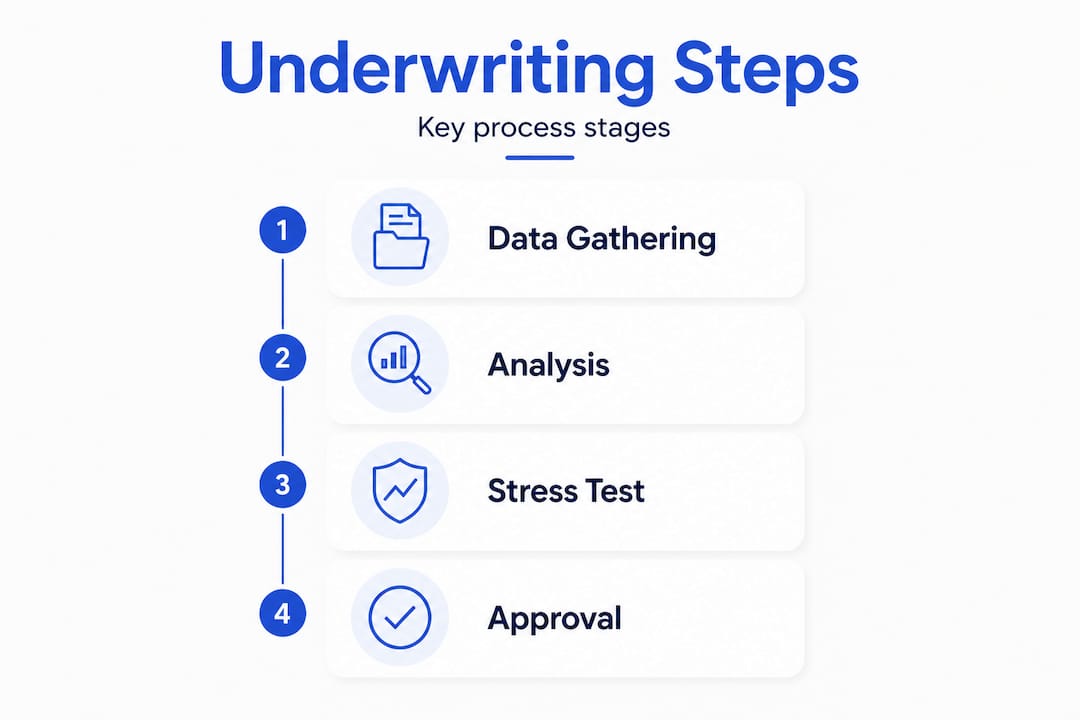
Stress testing is a critical component of the process that many borrowers do not anticipate. Lenders run scenarios that include rate and vacancy shocks: stress tests for interest rate increases of 150 to 200 basis points, vacancy increases of 10 to 15 percent, and NOI reductions of 10 to 20 percent. If the deal fails these tests, the lender may reduce the loan amount or decline entirely.
Edge cases require additional scrutiny. Self-employed borrowers with inconsistent income, thin credit profiles, high debt-to-income ratios above 43 to 50 percent, major lease expirations near loan maturity, and non-recourse loan requests all trigger manual review. These situations are not automatic disqualifiers, but they require more thorough documentation and explanation.
Understanding how AI underwriting works in modern platforms shows how technology can accelerate these steps, particularly data extraction and initial risk scoring, while still flagging edge cases for human review.
You can also reference property purchase steps in other markets to see how universal the sequential logic of underwriting is, regardless of geography.
Pro Tip: If you are an edge-case borrower, prepare a written narrative alongside your financials. Lenders respond better to documented explanations than to numbers that raise questions without answers.
Nuances and common challenges in underwriting
Now that you understand the “what” and the process, it is critical to master the nuances and recurring challenges that shape real-world underwriting decisions.
One of the most consequential gaps in underwriting is the difference between what a borrower projects and what a lender accepts. Lender NOI is typically 5 to 15 percent below the borrower’s pro forma, with lenders applying more conservative expense assumptions, lower occupancy credits, and higher reserve requirements. This gap directly reduces the loan amount available.
Loan sizing is not determined by a single metric. Lenders apply three constraints simultaneously, and the tightest one wins:
- DSCR (Debt Service Coverage Ratio): NOI divided by annual debt service. Most lenders require a minimum of 1.20x to 1.25x, meaning the property must generate 20 to 25 percent more income than the debt payment.
- LTV (Loan-to-Value): The loan amount as a percentage of the property’s assessed value. Typical commercial LTV limits range from 65 to 75 percent depending on asset class and lender.
- Debt Yield: NOI divided by the loan amount. This metric is increasingly used by institutional lenders and CMBS programs. A minimum of 8 to 10 percent is common.
If DSCR supports a $10 million loan but Debt Yield limits the loan to $8.5 million, the borrower receives $8.5 million. Understanding which constraint is binding before you submit allows you to structure the deal more effectively.
| Factor | Manual underwriting | AI-assisted underwriting |
|---|---|---|
| Processing speed | Days to weeks | Hours to minutes |
| Data extraction accuracy | Variable, human error risk | High, automated verification |
| Risk pattern detection | Experience-dependent | Systematic, data-driven |
| Edge case judgment | Strong, contextual | Limited, requires human review |
| Scalability | Low | High |
| Compliance tracking | Manual documentation | Automated audit trails |
AI-driven valuation tools are increasingly integrated into underwriting workflows, reducing the time required for data extraction and initial risk scoring. However, as the table illustrates, human judgment remains essential for edge cases, market context, and nuanced risk assessment that algorithms have not yet fully replicated.
Common pitfalls that derail deals include:
- Submitting pro formas with projected rents that are not yet in place and not clearly labeled as projections
- Ignoring the Debt Yield constraint when sizing a deal, particularly for bridge or CMBS financing
- Failing to account for near-term lease expirations that create income risk during the loan term
- Overstating property condition or understating deferred maintenance
Pro Tip: Never assume a lender will accept your pro forma at face value. Build your underwriting model using conservative assumptions, then present the upside as a separate sensitivity analysis. This approach signals financial sophistication and builds lender confidence.
Best practices for winning financing
Understanding the obstacles is only half the battle. Let’s turn to proven strategies you can use today to improve your approval odds and loan terms.
The investors who consistently secure favorable financing are not necessarily the ones with the best deals. They are the ones who present their deals most effectively within the framework lenders use to evaluate risk. The following practices make a measurable difference.
- Normalize operating expenses to sector benchmarks. Before submitting any package, compare your expense line items to published benchmarks for your asset class and market. Lenders will make these adjustments anyway. Doing it first demonstrates credibility and reduces the gap between your NOI and the lender’s.
- Stress test every deal before submission. Run your own scenarios using rate increases of 150 to 200 basis points and vacancy increases of 10 to 15 percent. If the deal does not pencil under stress, the lender will find it. Address the weakness proactively in your presentation.
- Document all income sources and lease terms with precision. Every rent figure should be traceable to a signed lease. Every other income line, such as parking, storage, or laundry, should be supported by historical data. Unexplained income is discounted or excluded.
- Use hybrid manual and AI tools for complex deals. AI platforms accelerate data organization, flag inconsistencies, and produce initial risk scores quickly. Human review adds the contextual judgment that algorithms miss. The combination produces faster, more accurate underwriting packages.
The 2025 institutional lending intelligence report highlights that lender NOI is typically 5 to 15 percent below the borrower’s pro forma, a gap that directly determines loan proceeds. Investors who account for this discount in their acquisition models avoid the surprise of receiving less capital than expected at closing.
- Keep your document package organized and complete from day one. Lenders prioritize deals that are easy to process. A disorganized package signals operational risk. Use a clear index, consistent naming conventions, and respond to information requests within 24 hours.
- Understand the asset-class-specific reserve requirements. Office properties require reserves of $0.15 to $0.25 per square foot annually. Multifamily properties require $250 to $400 per unit. These are not optional line items. They are standard lender adjustments that reduce your underwritten NOI.
Staying current on the future of commercial real estate financing trends also helps investors anticipate how underwriting standards are evolving, particularly as AI tools and alternative data sources reshape lender risk models.
A smarter way to approach real estate underwriting
With these best practices in mind, let’s challenge some common investor mindsets and show how a smarter, balanced approach truly wins.
The most persistent deal-killer in commercial real estate is optimism bias in investor pro formas. It is not fraud. It is a deeply human tendency to project the best-case scenario and present it as the base case. Lenders have seen this pattern thousands of times, and they have built systematic discounts into their underwriting to compensate for it. The investor who submits a conservative, well-supported model does not just get a faster decision. They get a more credible one.
There is a counterintuitive reality here. Investors who understand the lender’s actual constraints, specifically DSCR, LTV, and Debt Yield, and who build their models around those constraints rather than against them, consistently receive better terms. They are not gaming the system. They are demonstrating that they understand how capital is deployed responsibly. Lenders reward that fluency with speed, flexibility, and competitive pricing.
The hybrid AI and human underwriting model represents a genuine advancement, not just a marketing claim. AI systems surface data patterns and inconsistencies that human reviewers miss under time pressure. Human reviewers apply market context, relationship knowledge, and judgment on edge cases that algorithms cannot yet replicate. The future of CRE technology points clearly toward this collaboration becoming the institutional standard, not an exception.
The investors and business owners who position themselves ahead of this shift will have a structural advantage. They will submit cleaner packages, receive faster decisions, and close more deals at better terms. Caution and rigor in underwriting are not obstacles to deal velocity. They are the foundation of it.
Next steps: Streamline your underwriting and financing
The knowledge in this guide gives you a clear framework for approaching real estate underwriting with confidence and precision. The next step is applying that knowledge with tools built for the demands of modern commercial real estate financing.
CR Equity AI combines machine-learning underwriting, automated document intelligence, and real-time lender matching to deliver faster approvals and transparent terms across commercial real estate and small-business financing. Whether you are structuring a self-storage acquisition, a bridge loan, or a business term facility, the platform’s CRE loan services are designed to match your deal with the right capital efficiently. Use the loan quote calculator to get personalized financing estimates in minutes, and explore the resource hub for ongoing insights on AI advances, underwriting standards, and capital market trends.
Frequently asked questions
What are the main steps in real estate underwriting?
The main steps include rent roll analysis, normalizing expenses, NOI stabilization, cap rate determination, pro forma validation, and loan sizing via multiple constraints including DSCR, LTV, and Debt Yield.
Why do lenders discount borrower pro formas?
Lenders apply more conservative assumptions, typically discounting projections by 5 to 15 percent, to account for optimistic income estimates, understated expenses, and market risk.
How do stress tests impact underwriting?
Stress tests assess deal viability under adverse conditions, including rate increases of 150 to 200 basis points and vacancy increases of 10 to 15 percent, to confirm the asset can service debt even in a downturn.
What constraints matter most in loan sizing?
The tightest among DSCR, LTV, and Debt Yield determines the maximum loan size, regardless of what other metrics might support.
Can AI replace manual underwriting?
AI excels at data extraction and speed, but human judgment remains essential for nuanced risk assessment, edge case evaluation, and market context that algorithms cannot fully replicate.
Recommended
- The AI Underwriting Revolution in Commercial Real Estate | CR Equity AI
- How AI Underwriting Works in Commercial Real Estate | CR Equity AI
- The New Era of Digital Due Diligence: | CR Equity AI
- Blog | CR Equity AI
- Real estate crowdfunding: How it works and why it matters
- How to Leverage Real Estate Equity for Lasting Wealth